


Introduction to Canadian Search Funds
A search fund is an investment vehicle in which one or more entrepreneurial “searchers” raise capital from investors to seek and acquire an existing privately held company.
In Canada the model typically focuses on the lower‑mid‑market—businesses with enterprise values of roughly C$5 million–C$50 million and EBITDA of C$1 million–C$5 million. This size band is often too large for individual buyers but too small or succession‑dependent for traditional private‑equity funds.
How does it work? The searcher raises initial capital to finance an 18‑24 month search and later raises acquisition capital, typically giving early investors the option to co‑invest in the acquisition.
This report examines the state of Canada’s search fund ecosystem, emphasising mid‑market opportunities, succession trends, case studies and outlook into 2026. It draws on industry discussions, legal guidance and research reports and uses available data to create illustrative charts.
Demographic and Succession Drivers
Canada faces a succession wave as many founders approach retirement. According to the Canadian Federation of Independent Business (CFIB) and Business Development Bank of Canada (BDC), 61 % of SMEs are led by owners over 50, nearly one‑in‑five plan to exit within five years and 76 % expect to exit within 10 years, yet only 9 % have a formal succession plan. With so many businesses poised for transition and few successors, the search fund model offers a solution that preserves businesses while giving investors attractive returns.
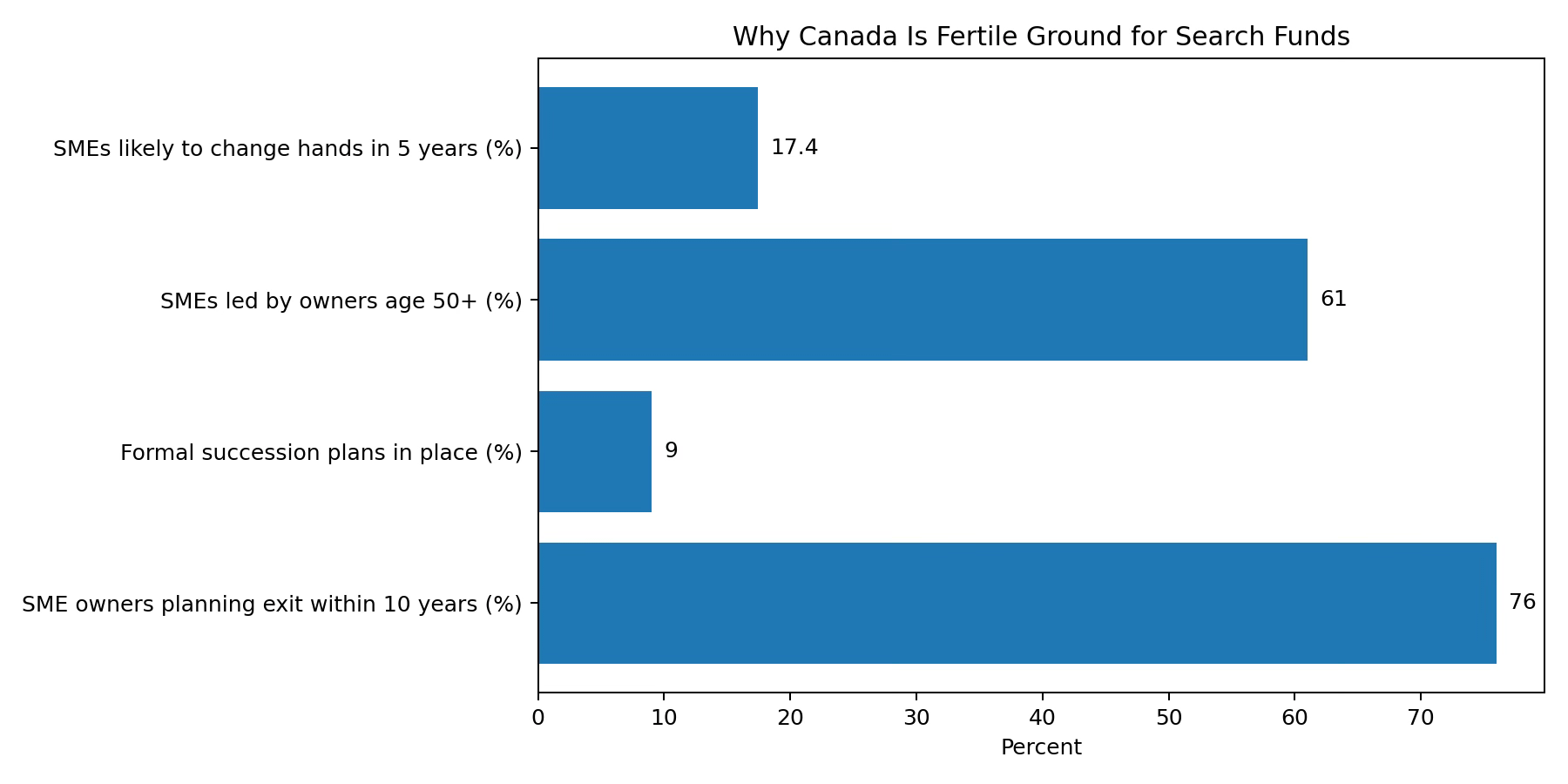
Figure 1: Succession gap among Canadian SME owners. The high proportion of older owners planning to exit highlights the opportunity for succession‑driven acquisitions.
Growth of the Canadian Search Fund Ecosystem
Expanding community - Toronto Search Fund Event Recap:
The community around search funds has grown rapidly. Stikeman Elliott’s Search Funds 2025: Toronto Seminar described increasing attendance at its annual search fund event, reflecting a vibrant and expanding ecosystem.
Panelists noted that investors are looking for searchers with financial acumen, leadership ability and genuine relationships with sellers.
Unlike the U.S. market, Canadian investors do not generally require an MBA; they focus more on preparation, coachability, operational experience and passion for operating a business.
The seminar emphasized that strong relationships with sellers can outweigh higher bids from private equity or strategic buyers. Searchers must commit to relocate for the right opportunity and show authentic concern for the seller’s legacy.
The discussion also highlighted differences between Canadian and U.S. markets: Canada lacks a U.S.‑style Small Business Administration loan program and the LLC structure, leading to a bias toward share deals rather than asset deals. Moreover, the market remains Toronto‑centric, making relationships and local networks crucial.
Once a business is acquired, panellists urged new CEOs to diagnose issues before prescribing solutions and to build resilient businesses with multiple paths to success. Success depends on humility, adaptability and team development. Managing the transition of previous owners is delicate: while many sellers become valuable mentors, others may hinder progress. Generally, the sooner the new owner can take full charge, the better for growth.
Ecosystem Partners and Funding Landscape
Investors and capital sources
Institutional programs – BDC launched the Thrive Entrepreneurship Through Acquisition Fund in 2025 (C$50 million) to support women acquiring businesses with C$1–5 million of EBITDA.
Funds such as Sage Capital Partners, Hadley Family Capital, Mineola Search Partners and the new Regenerative Capital Group provide committed capital and mentorship for searchers.
These investors often serve as board members post‑acquisition.
Debt providers – Acquisition financing typically combines senior debt with mezzanine or seller financing.
BDC, Roynat, CIBC Innovation Banking and credit unions offer senior or subordinated debt, while vendors often take back notes or rollover equity.
Professional advisors – Stikeman Elliott, Miller Thomson and Osler lead Canadian legal work on search funds.
They caution searchers to avoid U.S. LLC templates because LLCs are treated as corporations for Canadian tax purposes.
Canadian‐structured limited partnerships (LPs) better align with domestic tax rules.
Accounting and quality‑of‑earnings diligence is provided by firms like MNP and Kalos, which specialise in lower‑mid‑market transactions.
Talent and education – Universities and organisations have launched Entrepreneurship Through Acquisition (ETA) programs (e.g., Ivey’s ETA program, McGill’s Dobson Centre, Venture for Canada’s ETA Bootcamp).
Stanford’s 2024 study noted that 48 % of new searchers had taken an ETA class, up from 37 % previously, reflecting a professionalisation of the talent pipeline.
Case studies and outcomes
Several Canadian acquisitions demonstrate the search fund model:
Legado Capital – Kivuto
Purchased Ottawa‑based digital rights management firm in 2018 (source). Financing combined institutional investors, senior debt from TD and mezzanine from BDC. Sold to Valsoft in 2023, illustrating a full buy‑grow‑exit arc.
Explora Partners – Clariti/Camino
Acquired Clariti (enterprise permitting software) in 2020, grew from 20 to 100+ employees, acquired Camino (US permitting platform) and raised US$18 million from Vistara Growth. Later secured C$10 million facility from CIBC.
Balowick Capital – Rebel Vac Systems
In 2023, acquired a Western Canada industrial vacuum and hydro excavation business (source). Installed a new CEO (Curtis Colbary) and focused on preserving employee culture while pursuing growth.
While there are notable successes, search funds can be challenging. Stanford’s 2024 study found that of 681 traditional search funds, 328 completed acquisitions, 196 concluded without acquiring, and 157 were still searching, implying a success rate near 48 %. The distribution of outcomes is shown below.
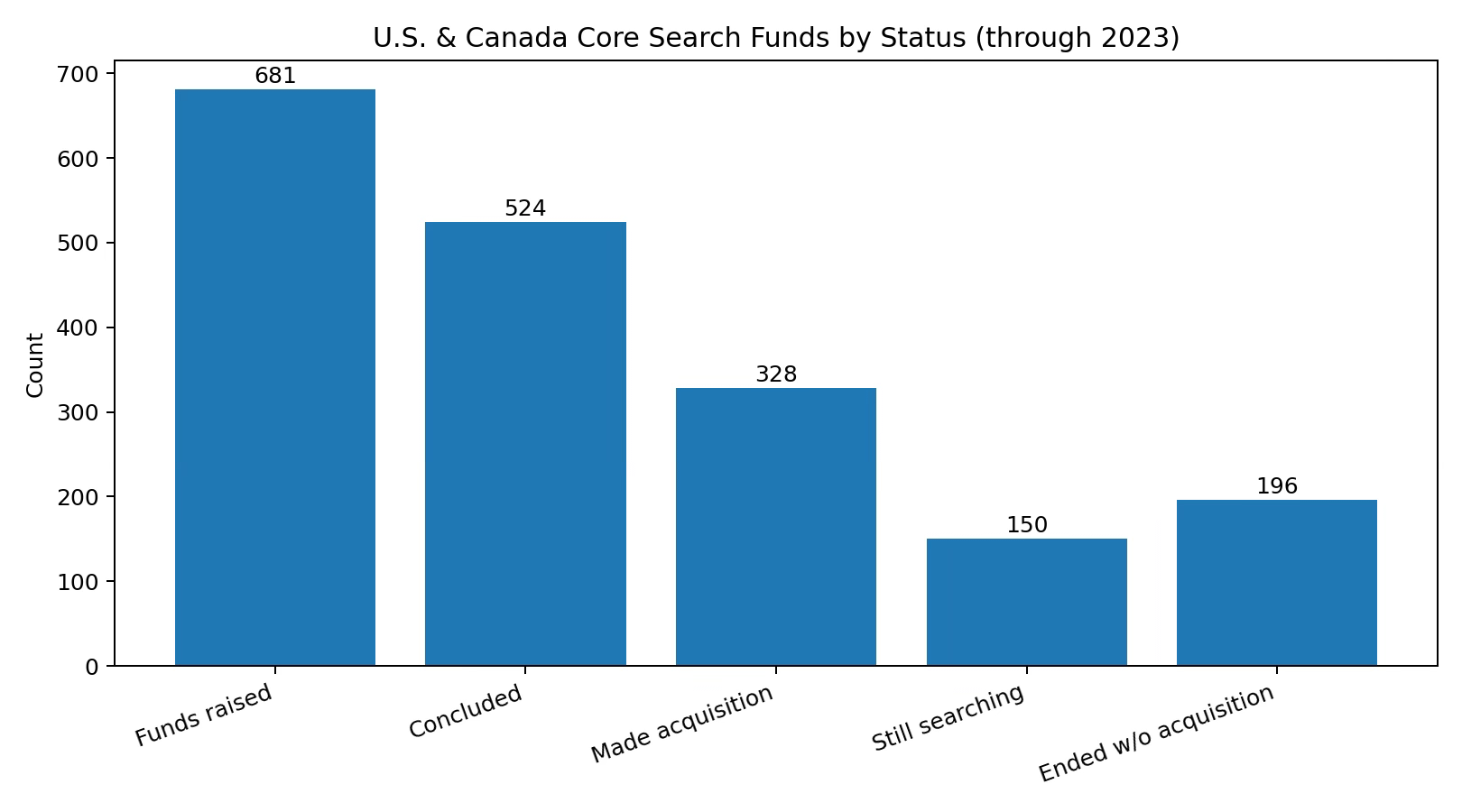
Figure 2: Outcomes of search funds in the Stanford GSB study (U.S. and Canada combined). Nearly half completed an acquisition while the remainder either wound down without buying a business or were still searching.
Acquisition Metrics and Deal Characteristics
Median metrics reported in Stanford’s 2024 study for U.S./Canada acquisitions provide a benchmark for Canadian searches:
Purchase price: US$14.4 million
EBITDA multiple: 7.0×
EBITDA margin: 27 %
Growth rate (trailing EBITDA growth): 25 %
Employees: 34
These metrics place acquisitions squarely in the lower‑mid‑market. Investors target profitable businesses with strong margins and growth potential. The following chart illustrates these median values.
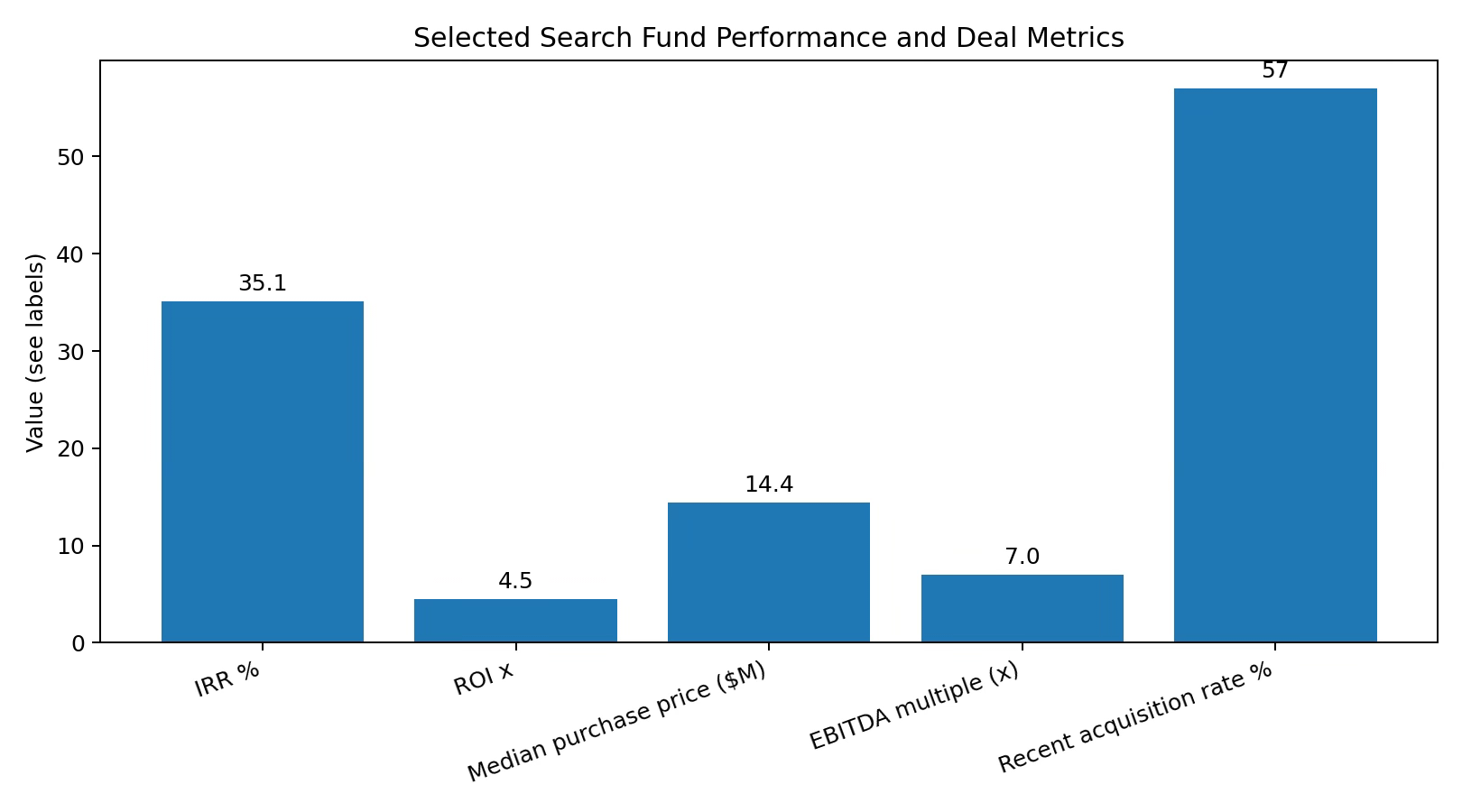
Figure 3: Median metrics of search fund acquisitions (U.S./Canada). Purchase prices and EBITDA multiples reflect lower‑mid‑market characteristics with healthy margins and growth.
Trends and Outlook for 2026
Rising number of searchers and diversified strategies
The search fund ecosystem in Canada is expected to continue expanding through 2026 as demographic pressures intensify and educational programs produce more trained searchers.
In addition to traditional search funds, self‑funded models and long‑term hold structures are gaining traction. Hybrid approaches that combine committed capital with the flexibility to operate beyond a typical five‑to‑seven‑year private‑equity timeline may offer another approach.
Competition and pricing: It’s a small pond
Mid‑market valuations remain elevated due to a scarcity of quality businesses and abundant capital. Long time horizons to cultivate authentic relationships and a willingness to relocate may help searchers win deals even when competing with higher bids. This can be especially with true with founder-operated family businesses.
As more private‑equity funds move down‑market, competition may increase. Searchers will need to differentiate through sector focus, operational expertise and seller alignment.
Financing conditions for search funds in Canada
Interest rates peaked in 2024 and gradually declined into 2025, and even with tepid forecasts for 2026, remain above the ultra‑low levels of the early 2020s. With other macroeconomic data points coming in soft, lenders are selective, emphasizing quality of earnings and downside protection.
Searchers should expect senior debt financing at moderate leverage (typically 2–3× EBITDA) combined with mezzanine or vendor notes. Creative capital stacks, including minority rollover equity, will remain common in Canada, particularly given the absence of a U.S. SBA‑style loan program.
Industry opportunities: Put winds in your sails
Geopolitical uncertainty has created an opportunity for Canadian supply chains and domestic manufacturing to step up. But action needs to be taken quickly.
Sectors potentially poised for growth include niche manufacturing, distribution and logistics, critical minerals, specialized industrial services, health‑care services and government‑mandated infrastructure.
The shift toward onshoring and the federal emphasis on clean‑technology supply chains (e.g., battery materials, renewable energy) will create acquisition targets with long‑term growth drivers and industries with demographic winds at their back may also be appealing.
Inclusivity and diversity
Canada’s search fund community is becoming more inclusive.
BDC’s Thrive Entrepreneurship Through Acquisition Fund is dedicated to female searchers.
Several universities are integrating ETA programs accessible to women and under‑represented groups.
There is of course work to be done but as the investor base diversifies, search funds will likely emerge across different regions (Atlantic Canada, the Prairies) rather than remaining Toronto‑centric.
Challenges for Canadian Search Funds
Search funds are not for the faint of heart.
Success requires passion, perseverance and embracing uncertainty.
Searchers may face long search periods, potential rejection from sellers and high opportunity costs.
Canadian searchers also contend with structural issues—lack of LLCs, share‑deal bias and fewer financing options compared with the U.S.—which can complicate deal structuring.
Entrepreneurship Through Acquisition (ETA) in Canada and Ontario
How ETA Relates to Search Funds
Entrepreneurship through acquisition (ETA) is a broad term that describes buying and operating an existing business instead of building one from scratch.
A search fund is a specific type of ETA vehicle: searchers raise capital from investors to fund the search process and investors gain rights of first refusal and a step‑up on that capital.
The more general ETA umbrella also encompasses self‑funded searches, management buy‑outs, holding‑company programs and impact‑investment initiatives that do not follow the classic search‑fund structure.
Misusing the term “search fund” to cover all forms of ETA can obscure differences in governance, financing and risk sharing.
Understanding this distinction is important because Canada’s ecosystem now supports both traditional search funds and other ETA pathways.
ETA Education and Training in Canada
Ivey Business School’s ETA program
Founded in 2023 through a partnership between the Ivey Business School and Toronto‑based Alcorn Partners, this exclusive program walks HBA and MBA students through identifying ventures, structuring deals and operating long‑established businesses.
The program’s objectives include introducing students to acquiring small‑to‑mid‑sized businesses, bringing in real‑world SMB owners to share lessons, creating networking opportunities and replicating successful programs at Harvard and Stanford.
Candidates are high‑achieving finance‑ and economics‑savvy students who may go on to investment banking, consulting or business ownership.
Ivey also notes that its alumni achieved Canada’s first successful search‑fund exit: Auxo Management’s purchase of a Toronto‑based video‑surveillance firm in 2014, which grew from 55 to over 2 000 employees and was sold to Garda World in 2024.
Haskayne School of Business ETA course
The University of Calgary’s Haskayne School of Business launched a new ETA course for MBA students in 2024. A brochure for the program frames ETA as a C$2 trillion succession opportunity by 2032 and notes that small‑to‑medium enterprises need successors because many founders lack a succession plan. Haskayne’s ETA course gives MBA students access to mentors and investors and aims to prepare them to acquire their own small business. The brochure highlights typical acquisition metrics from the Stanford search‑fund study – average purchase price around US$16.5 million, revenue US$6.4 million, EBITDA margin 22 %, and capital structures with roughly 50 % senior debt, 20 % seller‑financed debt and 30 % equity. These figures show that the course teaches searchers how to capitalise acquisitions typical of lower‑mid‑market businesses.
Venture for Canada (VFC) ETA Academy and Bootcamp – VFC launched an ETA Academy and Bootcamp to give mid‑career professionals a low‑risk way to test whether ETA is right for them. Applications for the inaugural cohort opened in November 2024, with classes starting in March 2025 and running for about six weeks. For C$1 200, participants receive roughly 40 hours of curriculum covering letters of intent (LOIs), projections, private placement memoranda, financial analysis, due diligence, funding options and negotiation. The program targets acquisition candidates for businesses valued between C$2 million and C$10 million and requires a commitment of about ten hours per week. VFC emphasises building a network of brokers, bankers, lawyers and investors and connecting participants to like‑minded buyers so that they have a community to support their search.
M&A Club of Canada and McGill’s Open‑Market ETA program – In February 2026 the M&A Club of Canada and McGill University’s Dobson Centre for Entrepreneurship announced a new two‑phase ETA program. Phase I is a training program where participants develop strategic, financial and operational skills and submit an investment‑thesis brief for consideration. Phase II, the ETA Lab, focuses on actively pursuing acquisitions by providing mentorship and direct engagement with investors, lenders and transaction partners. The program is open to professionals outside formal degree frameworks and is specifically designed to address Canada’s business‑succession gap by lowering barriers to acquisition and connecting entrepreneurs to investors. The organisers describe it as a response to the “silver tsunami” of retiring owners and emphasise the need for practical, hands‑on execution beyond theory.
Funding Initiatives and Ecosystem Support
BDC’s Thrive Entrepreneurship Through Acquisition Fund – In September 2025, BDC Capital launched the Thrive ETA Fund to address under‑representation of women in business ownership and to capture the succession wave. The initiative invests C$50 million through a unique equity structure: C$40 million is earmarked for direct investments in women acquiring established mid‑sized businesses and C$10 million is allocated to private‑equity and search‑fund investors that back women‑led acquisitions. The fund positions itself as a national platform that provides capital, mentorship and a supportive community so women can find, buy and grow businesses. It targets companies with EBITA between C$1 million and C$5 million and offers up to 25 % search capital alongside coaching and peer‑group support. The fund addresses both the gender ownership gap and the demographic succession gap as thousands of owners retire.
Regenerative Capital Group and other accelerators – Regenerative Capital Group runs a CEO‑in‑Residence program that recruits aspiring leaders to buy and grow businesses with funding, mentorship and a values‑driven community (focused on regenerative leadership and social impact). Although less formalised than a search fund, it demonstrates how ETA models can attract mission‑driven entrepreneurs. Likewise, Mineola Search Partners and Sage Capital Partners invest in Canadian ETA searches and acquisitions; BDC’s fund also provides indirect capital to such investors. These programs show that Canada’s ETA ecosystem is diversifying beyond traditional search funds and that there is appetite for operator‑development models.
Ontario‑Specific Insights
Ontario hosts some of the most active ETA institutions in Canada. Ivey’s ETA program is based in London, Ontario and draws participants from across the province.
Toronto is the base for several investors (Alcorn Partners, Mineola Search Partners and Sage Capital) and professional services firms with ETA expertise. The M&A Club’s Toronto chapter and McGill’s Dobson Centre (though in Quebec) collaborate with partners across Ontario.
The province’s concentration of SMEs and retiring owners makes it a fertile ground for ETA, and aspiring searchers.
Looking Ahead to 2026 and Beyond
The growing number of ETA programs and funds suggests Canada is moving toward a more robust acquisition‑entrepreneurship ecosystem. The timeline below highlights key milestones, illustrating how new programs have emerged almost annually and how funders have responded to the succession challenge.
In the near future, we can expect several trends:
Expansion of training pathways – As the Venture for Canada analysis notes, Canada still lacks accessible introductory ETA programs. New certificate courses, non‑credit bootcamps and online programs are likely to emerge to bridge the gap between curiosity and a formal search fund. These programs will probably leverage partnerships with universities, incubators and community colleges to reach a broader audience.
Greater diversity of acquisition models – With BDC’s Thrive fund explicitly supporting women and programs like Regenerative Capital Group focusing on mission‑driven buyers, ETA in Canada is diversifying beyond the traditional, MBA‑centred search fund. We may see more self‑funded searches, management buy‑outs and holding‑company models. Investors may develop flexible capital structures and fund‑of‑funds vehicles to support this diversity.
Increased availability of capital – BDC’s C$50 million allocation is just the beginning. Other institutional investors and family offices are likely to launch ETA‑focused funds or allocate capital to search funds, particularly as evidence of successful exits accumulates.
Standardisation of capital structures – Traditional search funds often finance acquisitions with roughly 50 % senior debt, 20 % seller‑financed or vendor debt and 30 % equity. These proportions, drawn from the Stanford study and highlighted in Haskayne’s ETA brochure, provide a template that self‑funded searches or ETA funds may adapt. The following graphic summarises this typical capital structure.
Focus on succession and social impact – Many ETA initiatives frame acquisitions as a way to preserve jobs, maintain local economic resilience and support founders’ legacies. As the M&A Club–McGill program stresses, the “silver tsunami” of retiring owners makes it a shared responsibility to lower barriers for capable entrepreneurs and maintain the continuity of established enterprises. ETA can therefore become part of regional economic‑development strategies, especially in Ontario where many owners are approaching retirement.
Recommendations for Aspiring Searchers
Develop genuine relationships – Early rapport with sellers and advisors can differentiate a searcher from private‑equity bidders and enable exclusive or off‑market deals.
Gain operational experience – Investors value leaders who have operated businesses or managed teams, not just MBAs.
Build a multidisciplinary team – Engage legal, accounting and due diligence partners early. Canadian‑specific tax and legal structures are crucial.
Focus on sectors with succession pressure – Target industries where demographics and regulatory trends create motivated sellers (e.g., manufacturing, logistics, services).
Plan for flexible capital stacks – Expect to combine equity, senior debt and vendor financing; maintain relationships with lenders and mezzanine providers.
Prepare for a long journey – Search funds can take years. Persistence and adaptability are critical.
Canadian Search Funds: In Conclusion
Canada’s demographic reality—an aging cohort of SME owners with limited succession planning—creates a once‑in‑a‑generation opportunity for search funds.
As 2026 unfolds, the ecosystem will continue to mature, with institutional funds (like BDC’s Thrive ETA) and a growing pool of trained searchers.
Success, however, will depend on more than capital: searchers must earn the trust of sellers, assemble experienced advisors, structure deals smartly and operate businesses with humility and strategic vision.
For investors and entrepreneurs willing to commit, the Canadian lower‑mid‑market offers attractive opportunities to acquire, build and steward the next generation of successful enterprises.
Risk Disclaimer and Intended Use: This guide is intended to act as an educational resource, - not a definitive recommendation. Please reference underlying sources directly for further details. This guide is not a recommendation to raise capital from investors, US-based or otherwise. If you need advice for your business, you are welcome to contact us for a referral.