

Testing can change the proposed treatment method, rather than merely confirm a plan already chosen.
Komline-Sanderson Group, Inc. acquired BI Pure Water (Canada) Inc. on October 30, 2025, according to seller adviser Generational and buyer counsel Fasken. Fasken calls it Komline’s first Canadian acquisition. The accounts do not disclose the price, currency, financing, seller identities or motives, or detailed assets and interests transferred. The deal’s economics and precise legal scope remain unresolved.
The businesses
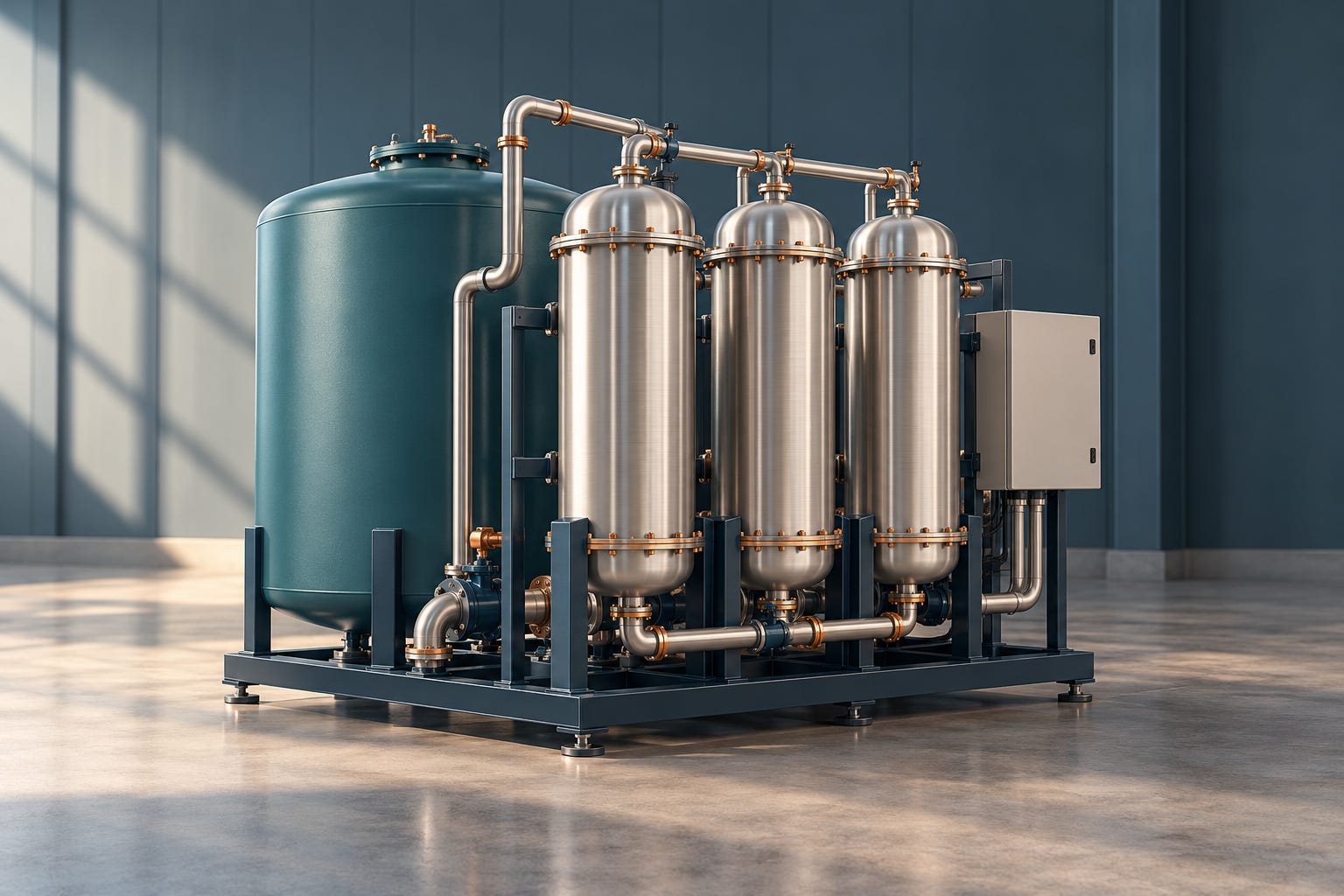
Generational describes Surrey-based BI as designing, building, commissioning and servicing custom modular and skid-mounted water and wastewater treatment plants since 1995. That is a chain of work, from a proposed system through manufacture and commissioning to service. It is the adviser’s account of the business, not an independently audited operating record.
Komline’s own history starts with Thomas Komline and Wally Sanderson in 1946 and the Coilfilter vacuum filter for sludge dewatering. It then traces expansion into other separation and processing equipment. The company says its 2021 acquisitions included Barnes International, Harn R/O Systems, AquaShield and Haselden, adding coolant filtration, reverse osmosis, stormwater and beverage-process activities. Those are company-reported milestones; they do not establish what each integration delivered. Its current, undated description also places engineers alongside manufacturing staff and service and installation technicians. That present description helps explain the operating business but is not an acquisition-date staff or facilities inventory.
On its current BI page, the buyer says the business will operate as Komline Pure Water, strengthening treatment-plant manufacturing and design. That is its stated rationale and current business description, not a report of achieved integration benefits.
The acquired role therefore sits alongside a history of separation technologies. That fit does not establish a particular project’s performance.
Komline’s current testing page describes a pilot facility and bench-scale laboratory where its applications team tests customer materials to identify process solutions. It specifies no sequence, acceptance criteria or requirement to move from one facility to the other.
Two operating examples
BI’s Rushmere project account describes a change in method. A 2007 sand-and-cartridge-filter pilot failed the stated water-quality objective and required frequent filter changes. A second pilot, using ultrafiltration, followed in summer 2008; the company reports full-scale plant commissioning in summer 2009. These are the supplier’s historical findings. The document also refers to September 2009 delivery and contains a later membrane update, so it does not establish a clear publication date or precise delivery-to-commissioning sequence. The useful result here is the reported move to another treatment method, not a transferable technical specification.
That work predates the acquisition; it cannot demonstrate an acquisition benefit.
Northern Ireland Water’s account describes an offline pilot comparing treatment alternatives simultaneously on the same raw water. The utility contrasts that with snapshot jar tests and describes real-time information informing permanent investment. It reports that the pilot moved to Ballinrees in 2021. The page is undated and does not establish when the initial Derg work occurred. This is the operator’s account, not an independent audit of performance or cost savings.
Rushmere describes a supplier’s sequential change of method in British Columbia; NI Water describes an operator’s simultaneous comparison in Northern Ireland. The periods, contaminants and arrangements differ. Both inform treatment choices, but neither establishes equivalent results or a method suitable for a reader’s site.
The purchasing decision
BI’s undated pilot guidance links treatment selection to source-condition coverage and operating information. We rely only on that general premise: the page contains unfinished and inconsistent anecdotes, which are excluded here. Its conditional discussion is not a rule that a pilot is always needed—or that existing data always makes one unnecessary.
Fictional procurement file: the project engineer says a summer-only pilot leaves spring-melt performance and replacement-filter consumption unresolved. The owner withholds the full-scale design commitment and requests a priced further-test or alternative-method proposal from that engineer: conditions to cover, operating records to obtain, and the decision point before design proceeds. The engineer defines the technical work; the owner does not select a treatment method through this purchasing exercise.
Countercase: the engineer instead supplies an assessment stating that relevant multi-year source data and operating information adequately support the proposed method. The owner requests a priced design proposal without automatically commissioning another pilot. The assessment and remaining design, regulatory and contractual approvals stay attached to the procurement file. Neither decision authorizes construction or certifies treatment performance; the people, records and conclusions are stipulated.
For general information and education, not legal, tax, investment or valuation advice. The fictional example is illustrative and does not predict your business’s value, financing terms or sale outcome. Consult qualified advisers about your situation.
Subscribe to Deal Flow Canada for practical owner guides and Canadian deal updates.