

For an Ontario industrial-property seller, preparation means connecting the buyer’s question to actual evidence. Start with the request’s purpose: transaction due diligence and preparing a record of site condition are different inquiries.
Read for the question answered
BDC’s environmental assessment overview explains the distinction between investigation phases. Phase One draws on historical records, interviews and observations to assess potential concerns. A historical account of activity and a sampling result answer different questions; neither should silently stand in for the other.
Under Ontario’s RSC framework, Phase Two includes planned investigation and sampling to establish contaminant locations and concentrations and assess applicable standards. A report describing sampling is not automatically a compliant Phase Two assessment.
Read the purpose, mapped property, findings and limitations together. A title cannot establish the question answered. Keep the author’s qualifications beside the findings in your summary.
Separate the Ontario filing question
Ontario’s brownfields overview describes a record of site condition, or RSC: it summarizes environmental condition based on assessments and includes qualified-person certification concerning applicable standards and intended use. A buyer’s or lender’s request does not itself establish that filing is required or available. Current rules restrict certain nonmandatory Phase-One-only filings and contain exceptions; obtain case-specific advice.
For RSC filing, section 32 of Ontario Regulation 153/04 includes current or past industrial use as a route to requiring Phase Two, independently of newly identified concerns. It also includes an activity-based route and specific exceptions. This does not mean every industrial-property sale requires an RSC.
The RSC rules condition report use on timing, changed concerns and other requirements, with review duties for a newly retained qualified person. They establish neither a universal sale-report expiry nor automatic adequacy for a recent report.
Two fictional files: read the pages, then frame the inquiry
The following documents, page numbers, people and events are entirely invented. Both sellers own Ontario manufacturing properties offered for continued industrial use. Neither has determined whether an RSC is required. These examples compare preparation work, not environmental outcomes.
File A: the missing coverage is explicit
Seller A supplies a 2022 report called Rear Yard Investigation, a 2024 storage-relocation memo and sale plan SP-1. The sale includes the main property, Parcel 1, and adjoining Parcel 2. A buyer’s written request asks for existing environmental information covering both parcels and the subsequent storage change.
Report A, page 2: the stated assignment was investigating the rear yard of Parcel 1.
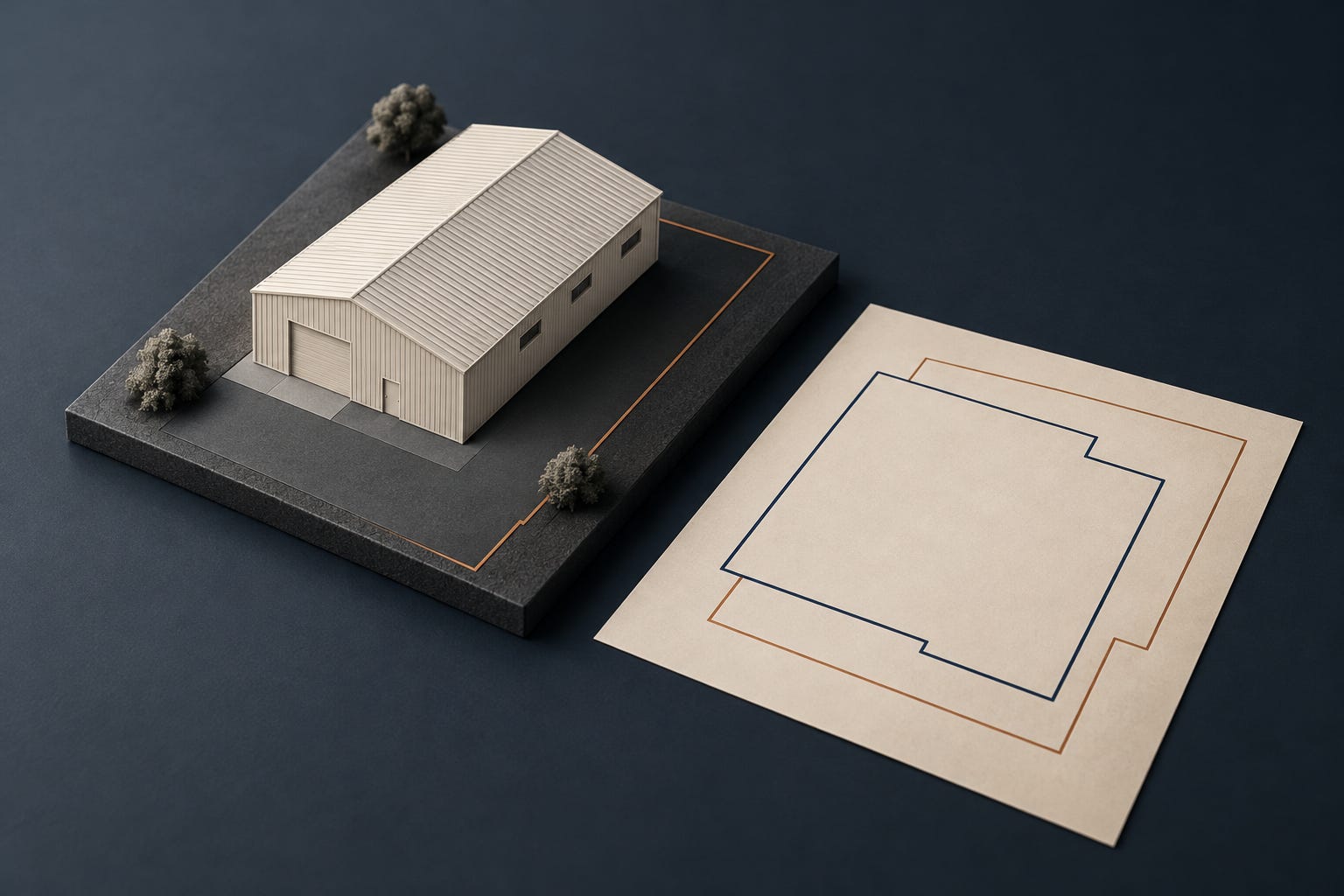
Page 4, figure 1: the assessed boundary encloses Parcel 1 and excludes Parcel 2.
Pages 9–12: sample identifiers, rear-yard locations and laboratory results appear together.
Page 18: the findings are expressly limited to that investigation; the report contains no assessment of Parcel 2.
Memo M-1, dated 2024: storage moved from the rear yard to a front enclosure on Parcel 1. Its attachment lists the materials moved.
Plan SP-1: the proposed sale boundary includes both parcels.
The absence of Parcel 2 coverage is an explicit fictional fact, not an inference from the report’s title. A has located usable descriptions of the earlier work, but has not located an assessment of the added land or later storage arrangement.
BDC’s environmental-issues guide identifies previous activities and hazardous-material storage as relevant history. Give the professional the memo and materials list. The relocation is a question to investigate, not proof of contamination or an automatic instruction to drill.
File B: the passages are available
Seller B has the same fictional sale boundary and storage change, but a different supplied file. Report B is dated 2026. Its title is Environmental Review for Proposed Sale. The seller has the complete report and the attachments listed below.
Page 3 identifies the assignment as considering the proposed sale of Parcels 1 and 2, with continued manufacturing stated as the proposed use.
Page 5, figure 2, reproduces the same two-parcel boundary as sale plan SP-1.
Pages 11–13 describe the 2024 storage relocation and cite memo M-1 and its materials list.
Appendix C contains the earlier rear-yard report and laboratory tables.
Pages 22–24 discuss those records together and state the author’s findings and limitations.
The attachment index lists SP-1 and M-1 by filename and date; both supplied files match those entries.
B can point to passages addressing the boundary and change, rather than first finding missing records. That makes the evidence easier to present; it does not establish technical adequacy, permission to rely, lender acceptance or freedom from further work.
Keep the industrial-use and RSC questions open in both cases.
A filled decision record for File A
Ontario’s Phase One guide explains documenting sources, reasoning and uncertainty. Its transitional material is not current filing authority. The working record below is an editorial aid, not a prescribed regulatory form or professional assessment.
Prepared by: Jordan Lee, seller’s operations manager. File set: A-2022, SP-1 and M-1. Recipient: environmental professional reviewing the proposed sale. Status: questions prepared; no technical answers received. Each entry below preserves a document reference and an unresolved question.
1. Intended purpose and use
Input: buyer request BR-1, paragraph 2, asks about both parcels and the storage change; SP-1 labels continued manufacturing. Recorded fact: those are the stated transaction instructions. The file contains no RSC determination.
Question: which due-diligence or RSC process applies?
2. Parcel coverage
Input: A-2022, page 4, versus SP-1. Recorded difference: the report map shows Parcel 1; the sale plan shows Parcels 1 and 2. Page 18 expressly excludes assessment of Parcel 2. No separate Parcel 2 report is in this fictional file.
Question: what evidence or investigation is needed for Parcel 2?
3. Findings and limits
Input: A-2022, pages 9–12 and 18. Recorded contents: rear-yard sample locations, laboratory results and the report’s limited findings.
Question: which findings can serve the present purpose?
4. Changed operations
Input: M-1 and its materials list. Recorded change: storage moved to the front enclosure in 2024. The memo does not record an environmental investigation of the relocation.
Question: how should the relocation and materials history affect the proposed scope?
5. Missing supporting information
Input: Jordan’s file inventory, version 1. The original memo, attachment and laboratory appendix are present; an environmental assessment of Parcel 2 and an investigation of the relocation are not. Jordan will check the company archive for additional records and log any additions by filename and date.
Question: which missing information matters to the conclusions, and why?
Turn the record into a defined next-work request
Send the referenced files with the record. Ask the professional to identify evidence that can serve the intended purpose, unresolved matters and the proposed scope of further work. Ask for the reasoning behind that scope. Neither file comparison promises acceptance, cost, timing or a particular investigation.
For File B, substitute its page and attachment references for A’s missing-record entries. Keep unanswered questions visible. This evidence packet does not establish that the property is clean.
For general information and education, not legal, tax, investment or valuation advice. Examples are illustrative and do not predict your business’s value, financing terms or sale outcome. Consult qualified advisers about your situation.
Subscribe to Deal Flow Canada for practical owner guides and Canadian deal updates.