

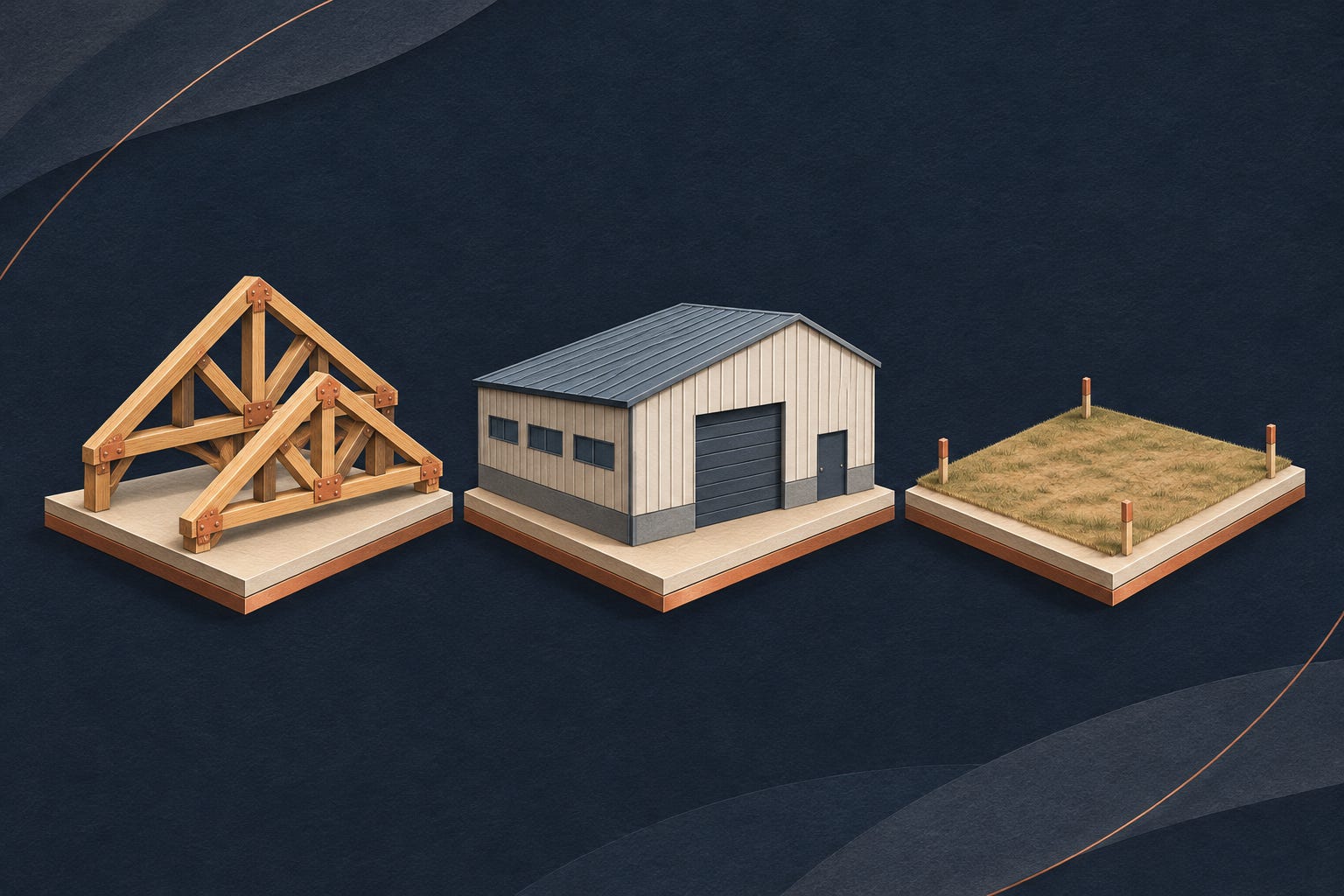
Atlas’s June 2, 2025 announcement reported buying all Truss-Worthy shares effective May 30. It identified a Colborne, Ontario roof-truss manufacturer and engineered-wood supplier, and separately described acquiring the landlord’s premises.
A business built around projects
Truss-Worthy’s company page traces its truss design and supply work to 1991. It describes working with architects, engineers, homeowners and custom builders, from large builders to people building their own homes. Roof-truss, floor-truss and engineered-wood projects feature in its offer, with service and advice alongside the products. The picture is of a business that responds to a customer’s project, rather than simply selling an interchangeable item off a shelf.
Customers are invited to send plans and ask about design services. That helps explain what an established relationship can contain: discussion of a project’s needs, with design as well as supply. It does not establish installation responsibility or the terms of a particular contract. The page is undated and its history is self-reported.
The group’s operating background
Atlas Building Systems’ About page gives another view of the group. It identifies the Nanaimo business as an AEP company, established in 1999. Its described work combines design with prefabrication of engineered floor joists, floor panels, wall panels and roof trusses. Developers and builders across Vancouver Island, the Sunshine Coast, Gulf Islands and Lower Mainland are its stated customers. That history belongs to this operating business, rather than establishing when the listed parent was founded.
Design and prefabrication meet different parts of a building project: planning a component and making it before it reaches the site. Having both in one described business helps explain why machinery alone is an incomplete picture of its offer. This undated page does not show that every group company makes the same products or serves the same regions. Its promises about helping with labour, scheduling and waste describe the proposition to customers, rather than measured acquisition benefits.
A different site, bought earlier
The original Colborne land announcement supplies the earlier step. On December 17, 2024, Atlas reported that its purchase of 42 acres at 281 Purdy Road had closed on December 12. Management wanted a new greenfield location supporting truss and panelization automation. It described Clinton as its first planned truss hub and Colborne as a future source of both trusses and wall panels. Those were two intended operating roles, rather than a report that both locations were already producing.
Land secured a location; creating the proposed operation was another job. Atlas also described engagement with European automation vendors. That identified a plan, rather than commercial output at Colborne: the operating result still lay ahead.
Business and premises were separate from the pre-owned site—a customer foothold ahead of potential development.
In Cascades’s packaging sale, the seller retained property and continued buying film after selling the operating business.
Penn: a different combination
The July 24, 2025 Penn-Truss announcement described another completed purchase of all target shares, effective that day. The Saltcoats, Saskatchewan business made roof and floor trusses and supplied engineered wood products. Land and buildings were excluded. Payment included deferred cash and a performance-dependent component payable in cash or Atlas shares at the buyer’s discretion. Purchasing every target share therefore did not mean paying entirely in buyer shares, or paying the whole headline consideration at closing.
Atlas highlighted equipment and an established delivery radius of 600 kilometres, based on historical business patterns. That describes past activity, rather than a guaranteed service boundary. It also identified an opportunity to expand wall-panel manufacturing, which had not previously been a significant or regular operation. The existing contribution and the possible next product activity were separate parts of the rationale. A proposed expansion should not be read back into what the acquired business was already doing regularly.
Land and buildings were excluded at Penn; Truss-Worthy’s premises were bought separately.
Acquired does not mean integrated
Atlas’s April 30, 2026 results release covered the year ended December 31, 2025. It said the two acquisitions were not fully integrated at year-end. Management attributed revenue growth to acquisitions and organic growth, while reporting competitive pressure on selling prices and margins. The larger group was still doing the work of integration; stronger revenue had not automatically delivered stronger margins. These were company-level observations, rather than a calculation of either target’s individual contribution.
The outlook had a different date from the financial period. In April, Atlas described Clinton’s building as nearing completion and expected its equipment to be operating in July 2026. Keeping those dates straight prevents a subsequent timetable from becoming a year-end operating fact. July was a forecast, rather than a verified start date.
From a plan to commissioning
The October 8, 2026 announcement reported completed commissioning of Atlas’s first robotic truss line in Clinton. Training and testing were underway on sellable roof-truss production runs. Management described a 42,000-square-foot automation facility and expected capacity and efficiency benefits. This was a concrete milestone at a named location, rather than a general automation ambition. It also distinguished what was complete—commissioning—from the training and testing still underway.
For an owner reading an expansion story, that distinction is useful. Sellable production runs describe an activity; they do not report steady-state throughput, unit cost or full utilization. A commissioning announcement cannot supply every subsequent operating measure, and it provides no basis for transferring its results to another location. Keep the reported milestone separate from the benefits management expects to follow it.
April’s forecast and October’s commissioning report describe different stages. Read the milestone actually reported, rather than assuming that a timetable proves full operation.
For general information and education, not legal, tax, investment or valuation advice. Reported transactions do not predict your business’s value, financing terms or sale outcome. Consult qualified advisers about your situation.
Subscribe to Deal Flow Canada for practical owner guides and Canadian deal updates.